Can a Deep Bite Affect Sleep? What Parents of Children Under 10 Should Know
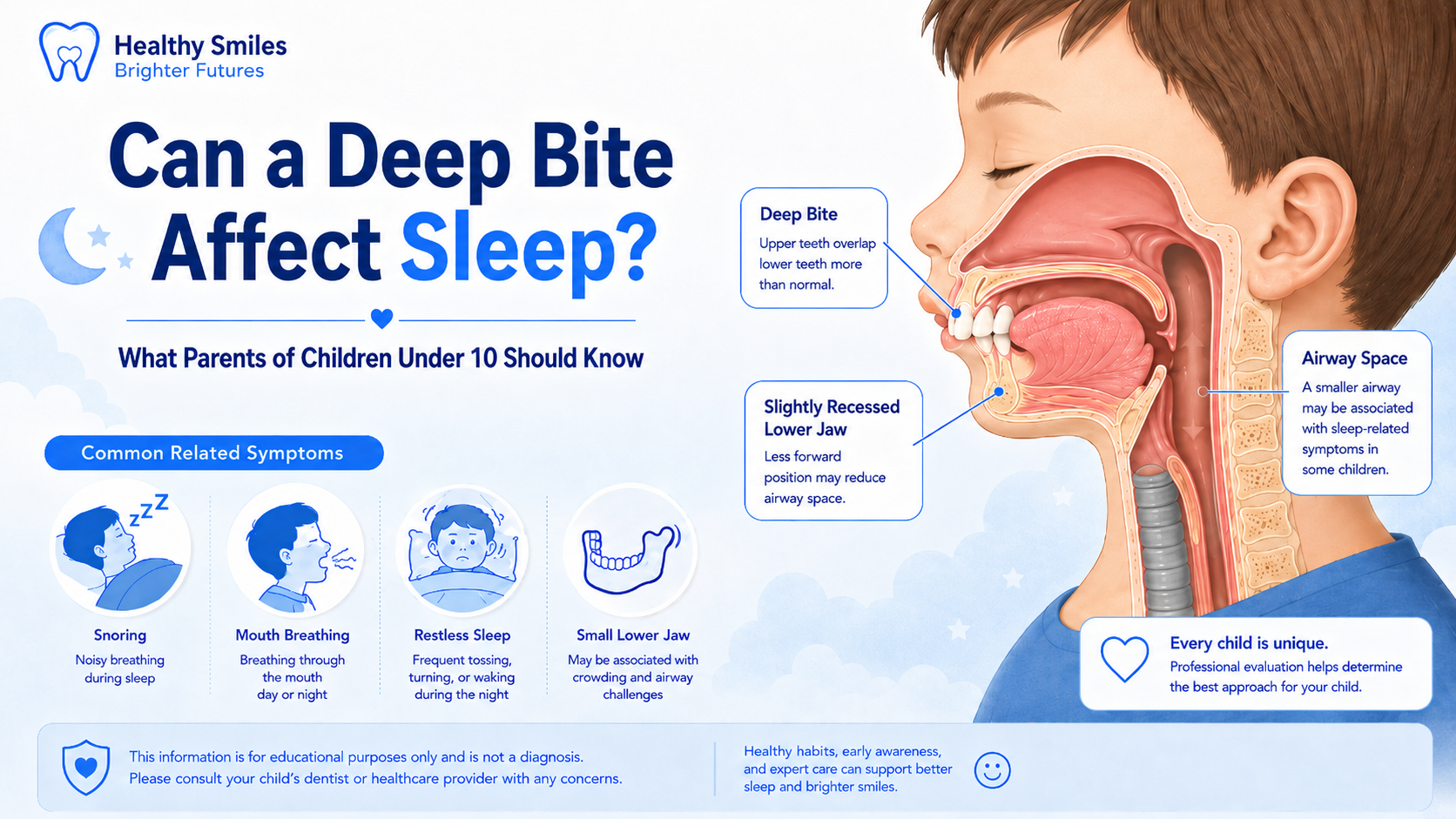
Can a Deep Bite Affect Sleep? What Parents of Children Under 10 Should Know
Parents often think of a deep bite as mainly a dental or cosmetic concern. However, the way a child’s upper and lower jaws grow can also influence chewing, facial development, tongue space, and, in some children, the size and stability of the upper airway.
A deep bite does not automatically mean that a child has obstructive sleep apnea. Still, when a deep bite appears with loud snoring, mouth breathing, restless sleep, or a small or backward-positioned lower jaw, it may be an important clue that further evaluation is needed.
Early evaluation is especially important for children under age 10 because the jaws, dental arches, facial bones, and airway are still developing. Identifying growth concerns early can help parents understand what is happening and determine whether monitoring, orthodontic care, or medical referral is appropriate.
What Is a Deep Bite?
A deep bite occurs when the upper front teeth overlap the lower front teeth more than expected. In more substantial cases, the lower teeth may touch the roof of the mouth or the gums behind the upper teeth.
A deep bite may develop because of:
- – The position or angle of the front teeth
- – A lower jaw that sits farther back
- – Differences in upper- and lower-jaw growth
- – Strong facial or chewing muscles
- – Missing, worn, or improperly positioned back teeth
- – Genetics and inherited facial-growth patterns
Because children under age 10 are still growing and transitioning from baby teeth to permanent teeth, the dentist must evaluate the entire bite, not just the amount of overlap between the front teeth.
What Is Obstructive Sleep Apnea in Children?
Pediatric obstructive sleep apnea, often called OSA, occurs when a child’s upper airway repeatedly becomes partially or completely blocked during sleep. These interruptions can reduce airflow, disturb sleep, and force the child’s body to work harder to breathe.
Enlarged tonsils and adenoids are major risk factors for pediatric OSA. Nasal obstruction, allergies, obesity, neuromuscular conditions, and certain craniofacial growth patterns may also contribute.
Children with a deficient midface or a small or retruded lower jaw may have less space available behind the tongue, which can increase airway concerns during sleep.
Is There a Connection Between a Deep Bite and Sleep Apnea?
A deep bite itself does not prove that a child has sleep apnea, and it should not be described as the sole cause of an airway problem.
However, some children with a deep bite also have a retruded lower jaw, sometimes called a recessed jaw. When the lower jaw rests farther back, the tongue may also sit closer to the back of the throat. During sleep, relaxed muscles can make an already narrow airway more likely to become restricted.
Research has found that children with OSA may have higher rates of certain bite and jaw differences, including mandibular retrusion, abnormal overbite or overjet, narrow upper jaws, and crossbites. Still, facial appearance or bite characteristics alone cannot determine whether a child has OSA.
A deep bite should be viewed as one part of a comprehensive airway and orthodontic assessment, especially when sleep-related symptoms are also present.
This is why deep bite sleep apnea concerns should be evaluated carefully instead of being ignored or assumed to be caused by the bite alone.
Signs Parents Should Not Ignore
Occasional light snoring during a cold is not always a sign of sleep apnea. Frequent or intense symptoms, however, should be addressed.
Parents should speak with a healthcare provider if a child regularly experiences:
- – Loud or frequent snoring
- – Pauses in breathing, gasping, or choking during sleep
- – Restless sleep or unusual sleeping positions
- – Persistent mouth breathing
- – Difficulty waking in the morning
- – Morning headaches
- – Bedwetting after previously staying dry
- – Irritability, hyperactivity, or difficulty concentrating
- – Daytime fatigue
- – Poor school performance
- – Slow growth or feeding difficulties
Children do not always show sleepiness the same way adults do. In some children, disrupted sleep may appear as excessive energy, poor attention, mood changes, or behavioral concerns.
The American Academy of Pediatric Dentistry recommends screening children for signs of obstructive sleep apnea, including snoring, mouth breathing, pauses in breathing, morning headaches, bedwetting, and daytime behavior changes.
Why Evaluation Before Age 10 Can Be Important
A child’s jaws, facial bones, dental arches, and airway are still developing during the early and mixed-dentition years. Identifying an unfavorable growth pattern early may give the dental team an opportunity to monitor development and devise an appropriate plan before the problem becomes more difficult to address.
An early orthodontic evaluation does not mean that every child needs braces immediately. Treatment timing depends on the child’s:
- – Age and stage of dental development
- – Jaw-growth pattern
- – Severity of the deep bite
- – Available space for permanent teeth
- – Breathing and sleep symptoms
- – Ability to cooperate with treatment
- – Overall medical and dental needs
The goal is to understand the child’s growth pattern and decide whether observation, orthodontic treatment, or medical referral is the best next step.
What Will the Dentist Evaluate?
During an examination, the dentist or orthodontic provider may assess:
- – How far the upper teeth overlap the lower teeth
- – Whether the lower jaw appears recessed
- – The relationship between the upper and lower jaws
- – The width and shape of the upper dental arch
- – Crowding or crossbite
- – Tongue position and available tongue space
- – Signs of mouth breathing
- – Tooth wear or gum irritation from the deep bite
- – The appearance of the tonsils and oral airway
- – The child’s sleep and breathing history
The dental exam can help identify risk factors, but a dentist does not diagnose sleep apnea based only on the bite, an X-ray, or the appearance of the airway.
How Is Pediatric Sleep Apnea Diagnosed?
If a child snores and has other symptoms of obstructive sleep apnea, the dentist may recommend evaluation by a pediatrician, ENT specialist, pulmonologist, or sleep medicine physician.
An overnight sleep study, also called polysomnography, is commonly used to confirm or refute a diagnosis and determine the severity of pediatric OSA.
Parents should not assume that a child will simply outgrow persistent snoring. Early recognition can facilitate appropriate care and help protect sleep quality, behavior, learning, growth, and general health.
Can Orthodontic Treatment Help?
Orthodontic treatment may help selected children when a true jaw or dental problem is present. Depending on the diagnosis, treatment may be designed to:
- – Correct a harmful deep bite
- – Guide lower-jaw growth
- – Improve the relationship between the jaws
- – Widen a narrow upper arch
- – Create healthier space for the teeth and tongue
- – Improve chewing and long-term bite stability
Some studies report improved breathing measurements after treatments such as maxillary expansion or mandibular advancement in carefully selected children. However, orthodontic treatment should not be promoted as an automatic or stand-alone cure for pediatric sleep apnea.
Correcting a deep bite may enhance dental function and support healthier jaw development, but it cannot guarantee that sleep apnea will resolve. Enlarged tonsils, nasal obstruction, allergies, weight, and other medical factors may still need to be addressed.
A Team Approach Is Often Best
Children with both bite concerns and sleep-related breathing symptoms may benefit from a coordinated evaluation involving the family dentist, orthodontic provider, pediatrician, ENT specialist, and sleep physician.
The purpose of early dental screening is not to alarm parents or proclaim that every deep bite is an airway disorder. It is to recognize when several signs may be connected and help families seek the right evaluation at the right time.
Schedule an Evaluation
If you have deep bite sleep apnea concerns for your child, an early dental and airway-focused evaluation can help determine the most appropriate next step.
When a child under age 10 has a deep bite, recessed lower jaw, persistent mouth breathing, or frequent snoring, an early evaluation can provide useful information about the child’s dental and facial development.
At Ortega Dental Care, we evaluate the developing bite, jaw relationships, oral habits, and possible airway warning signs. When needed, we help families coordinate care with the appropriate pediatric medical or sleep specialist.
Early evaluation does not always lead to immediate treatment, but it can help parents understand the problem, monitor growth, and determine the most appropriate next step for their child.