Early Jaw Correction in Children: Class II and Class III Timing
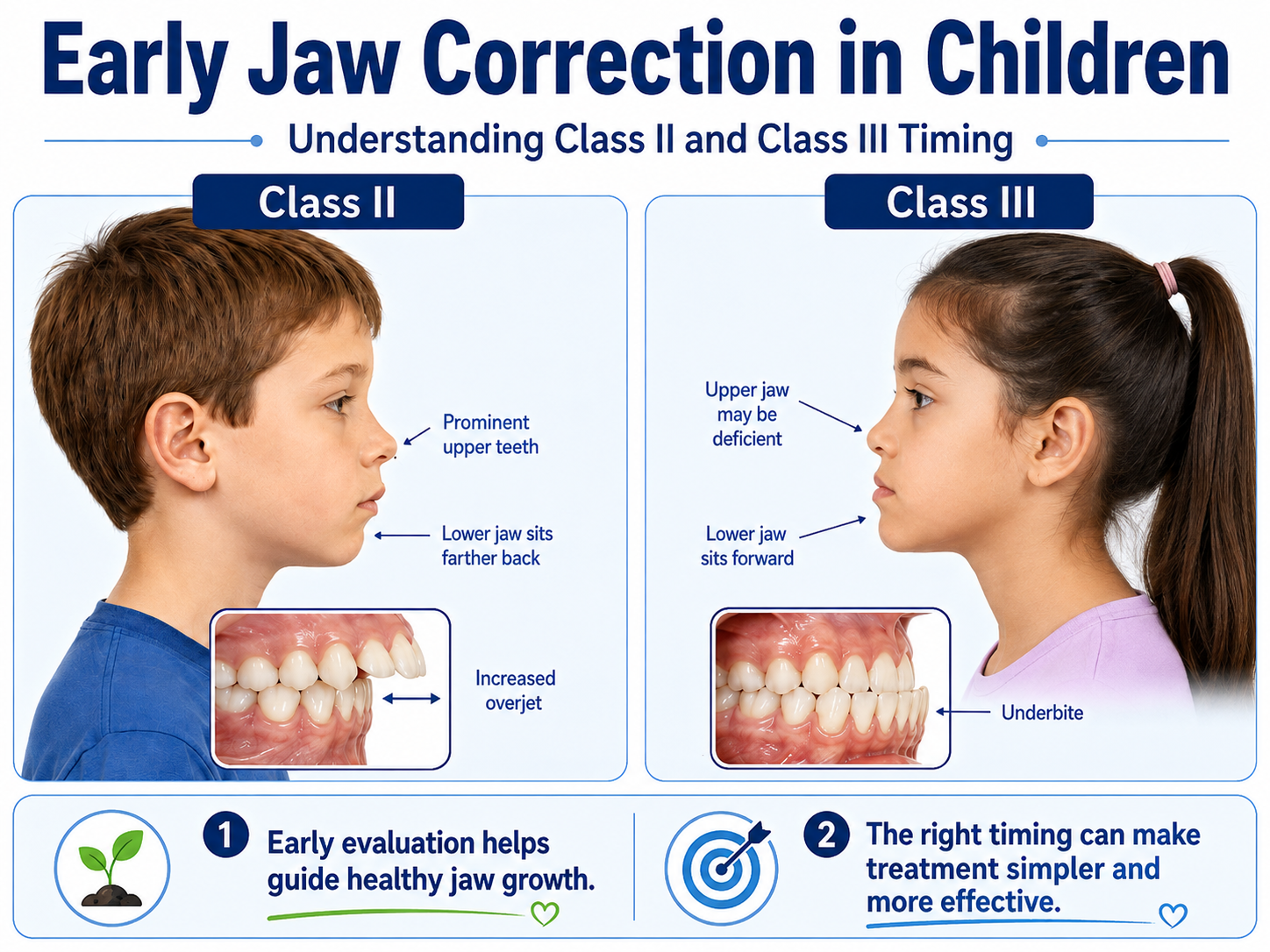
Early Jaw Correction in Children: Class II and Class III Timing
As a dentist, one of the most common questions I hear from parents is: “Should we begin treatment now, or should we wait until all the permanent teeth come in?”
The answer depends on the type of jaw imbalance, the child’s stage of growth, the severity of the bite, and what we are trying to accomplish. Early jaw correction in children can be very helpful in certain situations, but not every child needs treatment right away.
An early orthodontic evaluation does not automatically mean early braces. Its purpose is to identify a developing problem and determine the most effective time to intervene. Sometimes the best recommendation is early treatment. Other times, the best recommendation is careful monitoring until the child reaches a better stage of growth.
What Are Class II and Class III Jaw Relationships?
Class II and Class III jaw relationships describe how the upper and lower teeth and jaws fit together. These bite patterns can affect chewing, facial balance, tooth wear, lip closure, and future orthodontic treatment needs.
A Class II bite occurs when the lower teeth and jaw sit behind the upper teeth and jaw. Parents may notice:
- – A small or recessed-looking chin
- – Upper front teeth that appear prominent
- – A large horizontal space between the upper and lower front teeth
- – Difficulty comfortably closing the lips
- – A deep bite where the upper teeth cover too much of the lower teeth
Although Class II problems are frequently associated with a lower jaw that is positioned farther back, they may also involve upper-jaw prominence, tooth position, or a combination of these factors.
A Class III bite, commonly called an underbite, occurs when the lower teeth bite in front of the upper teeth. Parents may notice:
- – Lower front teeth positioned ahead of the upper front teeth
- – A prominent-looking lower jaw or chin
- – A flatter or less prominent middle portion of the face
- – An upper jaw that appears narrow or underdeveloped
- – The jaw shifting forward or sideways as the child closes
A Class III relationship may result from insufficient forward growth of the upper jaw, excessive growth of the lower jaw, tooth position, or a combination of these conditions. This distinction is important because treatment should address the source of the problem rather than simply move the teeth.
Why Is an Orthodontic Evaluation Recommended Around Age Seven?
By approximately age seven, children usually have a mixture of baby teeth and permanent teeth. This allows the dentist or orthodontist to examine the developing bite, jaw relationships, eruption pattern, facial balance, and available space.
The American Association of Orthodontists recommends that children be screened by age seven. However, not every child examined at that age needs immediate treatment. Some children require intervention, while others enter an observation program with periodic growth and eruption checks.
The American Academy of Pediatric Dentistry also emphasizes the importance of proper diagnosis, complete records, and appropriate treatment timing when managing developing dentition and occlusion.
In other words, age seven is an evaluation milestone for early jaw correction in children, not a universal starting age for appliances or braces.
When Does Early Jaw Correction in Children Make Sense for Class II Bites?
For many children with a Class II bite, treatment can be timed closer to the adolescent growth spurt. During this period, the child’s remaining growth, along with tooth movement, may help improve the bite and facial balance.
Common treatment options may include functional appliances, such as a Twin Block or Herbst appliance, limited or comprehensive braces, headgear in selected cases, or other customized approaches. The appropriate appliance depends on the child’s skeletal pattern, dental development, cooperation, and treatment objectives.
Starting Class II treatment very early does not automatically produce a better final jaw relationship. Research has shown that children treated in two phases do not always have a better final overjet or skeletal relationship than children treated later in one phase.
However, early Class II treatment may be appropriate when a child has:
- – Severely protruding upper front teeth
- – A substantial risk of injuring the front teeth
- – Difficulty closing the lips comfortably
- – A traumatic deep bite
- – Significant functional concerns
- – Facial or dental concerns that are affecting the child socially or emotionally
- – Another bite problem that should be corrected before comprehensive treatment
Research also suggests that early treatment for children with prominent upper front teeth can reduce the risk of new dental injuries. Even when the final orthodontic result is similar to treatment started later, early treatment may still provide a meaningful protective benefit for certain children.
Therefore, the question is not simply, “Can we treat this Class II bite early?” The more important question is, “Is there a meaningful benefit to treating this particular child early?”
Why Is Class III Timing Often Different?
Class III problems often require earlier attention than Class II problems, especially when the upper front teeth are trapped behind the lower teeth or the upper jaw is not developing sufficiently forward.
An anterior crossbite should not be ignored. When the lower jaw must shift forward to close the teeth together, that functional shift may contribute to an unfavorable bite pattern, uneven tooth wear, or facial asymmetry.
For selected growing children, early Class III treatment may include:
- – Correction of an anterior crossbite
- – Maxillary expansion when the upper jaw is narrow
- – A protraction facemask to encourage forward correction of the upper jaw
- – Partial braces or other appliances to guide the teeth
- – Growth observation combined with staged treatment
Research indicates that early facemask treatment can generate positive short-term skeletal and dental improvements in children with Class III malocclusion, although the strength of evidence varies depending on the appliance, the child’s growth pattern, and the long-term outcome.
Can Early Class III Treatment Prevent Jaw Surgery?
Early treatment may reduce the severity of a Class III problem and may lower the chance of future jaw surgery in selected patients. However, no dentist or orthodontist can perfectly predict a young child’s complete future growth.
Class III growth can be especially unpredictable because the lower jaw may continue growing into the teenage years and sometimes beyond. This means early treatment may improve the bite during childhood, but future monitoring is still very important.
Parents should understand that early Class III treatment may:
- – Improve the bite during childhood
- – Encourage more favorable upper-jaw development
- – Improve facial balance and function
- – Reduce the severity of later treatment
- – Possibly reduce the need for future jaw surgery
The goal is not to promise that surgery will never be needed. The goal is to treat at the right time when growth guidance may still provide a meaningful benefit.
Early Treatment Usually Does Not Replace Later Treatment
When early jaw correction in children is recommended, it is commonly described as Phase I treatment. Its purpose is to address a specific developing problem while the child still has a mixture of baby and permanent teeth.
After Phase I, there is usually a period of observation. Once most or all permanent teeth have erupted, some children require Phase II treatment with braces or clear aligners to refine tooth alignment and the final bite.
Phase I treatment should have a clear and tangible objective. It should not be started simply because a child has reached a certain age. Appropriate early treatment is designed to accomplish something that may be more difficult, less predictable, or more invasive if postponed.
Signs That Should Prompt an Earlier Orthodontic Evaluation
Parents should arrange an orthodontic evaluation if they notice:
- – Lower front teeth biting ahead of the upper teeth
- – Upper front teeth that protrude substantially
- – A chin that appears markedly recessed or prominent
- – The lower jaw shifting when the child closes
- – Difficulty biting or chewing
- – The teeth biting into the palate or gum tissue
- – Early or unusual wear of the front teeth
- – Facial asymmetry
- – Difficulty closing the lips over the front teeth
- – A family history of a severe underbite or jaw surgery
A family history of Class III growth is especially relevant. Genetics do not determine every outcome, but they can provide an important clue about how a child’s facial pattern may develop.
Monitoring Is Also a Treatment Decision
Growth observation is an active process. It may involve periodic examinations, photographs, measurements, and updated imaging when clinically appropriate.
Monitoring allows the dentist or orthodontist to identify the stage at which treatment is most likely to be efficient and effective. Beginning too early may prolong care without improving the final result, while beginning too late may reduce certain growth-modification opportunities.
This is why early orthodontic evaluation is so important. It allows parents to understand whether treatment should begin now, later, or not at all.
The Right Time Is Different for Every Child
There is no single appliance or starting age that is appropriate for every Class II or Class III patient.
In general:
- – Class II treatment is often most efficient when coordinated with the child’s adolescent growth spurt, unless severe overjet, trauma risk, function, or another concern justifies earlier intervention.
- – Class III treatment often deserves earlier evaluation and may benefit from treatment during the primary or early mixed-dentition years, especially when an anterior crossbite or upper-jaw deficiency is present.
- – Observation may be the correct recommendation when immediate treatment would not provide a substantial advantage.
The goal of an early orthodontic consultation is not to place every child into treatment. It is to create an individualized plan so treatment begins at the stage when it can provide the greatest benefit with the least unnecessary burden.
At Ortega Dental Care, we evaluate each child’s bite, jaw growth, airway-related concerns when appropriate, facial balance, and dental development. If your child has a noticeable overbite, underbite, jaw shift, or protruding front teeth, an early orthodontic evaluation can help determine whether early jaw correction in children may be helpful. Patients can also contact our office directly or request an appointment through our website to schedule an evaluation.