Why Early Orthodontic Treatment Matters for Children Who Suck Their Thumb
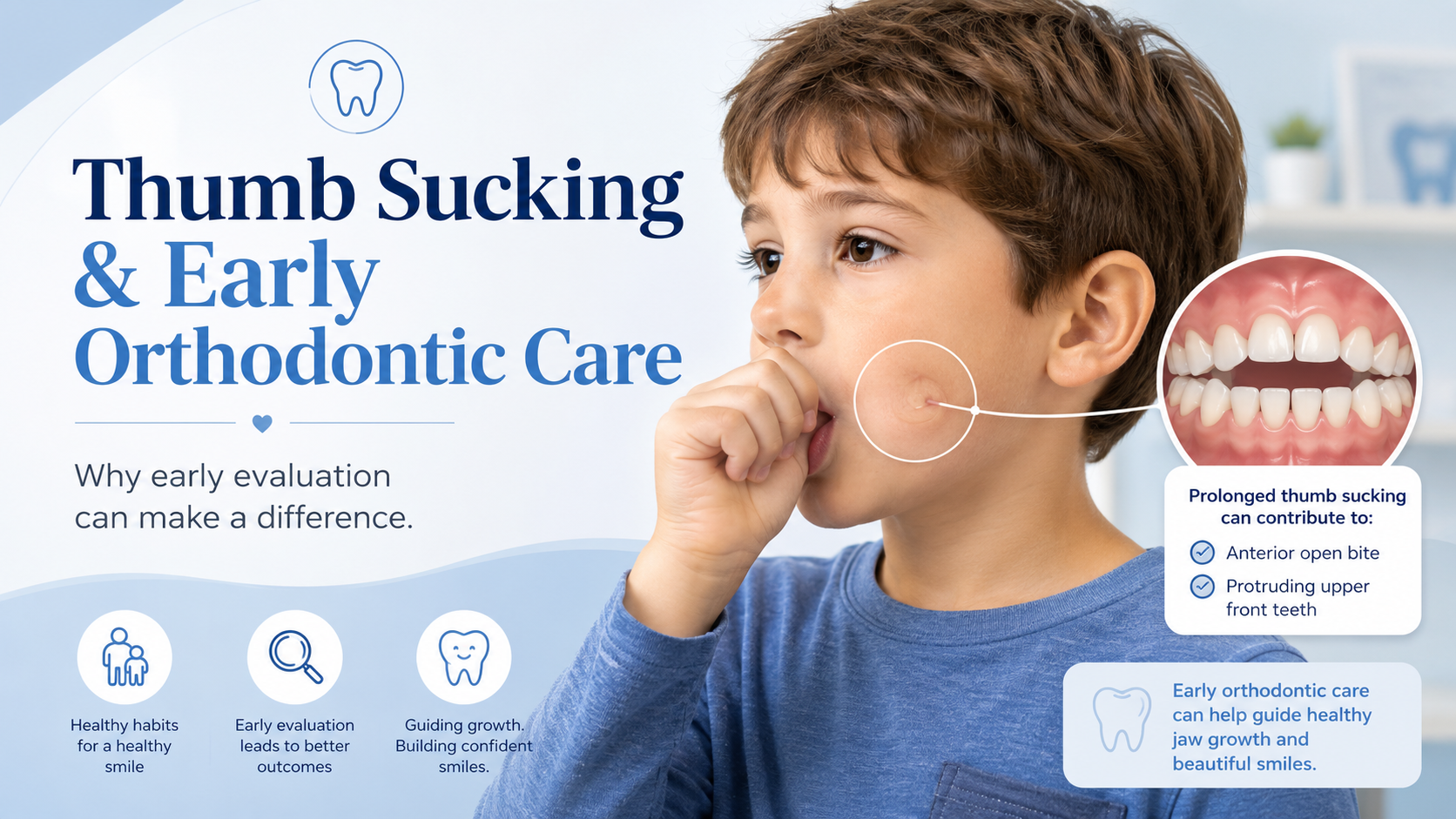
Why Early Orthodontic Treatment Matters for Children Who Suck Their Thumb
Thumb sucking is a natural self-soothing habit for babies and young children. Many children stop on their own between ages 2 and 4 without long-term dental problems.
However, when thumb sucking continues beyond the preschool years, it can affect how the teeth, jaws, facial muscles, and bite develop. In some children, prolonged thumb sucking can contribute to orthodontic problems that become harder to correct as the child grows.
Early evaluation can make a substantial difference. The goal is not to rush every child into treatment. The goal is to identify whether the habit is starting to change the bite or jaw growth before those changes become more difficult to correct.
How Thumb Sucking Affects Teeth and Jaw Growth
A child’s face and jaws are still developing, which means they can be influenced by repeated pressure over time. A thumb placed in the mouth for hours each day can apply gentle but continuous force to the teeth and dental arches.
Over time, prolonged thumb sucking may contribute to:
- – An anterior open bite, where the front teeth do not touch when the back teeth are together
- – Protruding upper front teeth
- – Increased overjet
- – A narrow upper jaw
- – Posterior crossbite
- – Changes in tongue posture
- – Changes in swallowing patterns
- – Speech difficulties with sounds such as “S,” “Z,” and “TH”
These problems do not happen in every child, and the severity depends on how often, how long, and how forcefully the child sucks their thumb. However, when changes do develop, they often become more difficult to correct later.
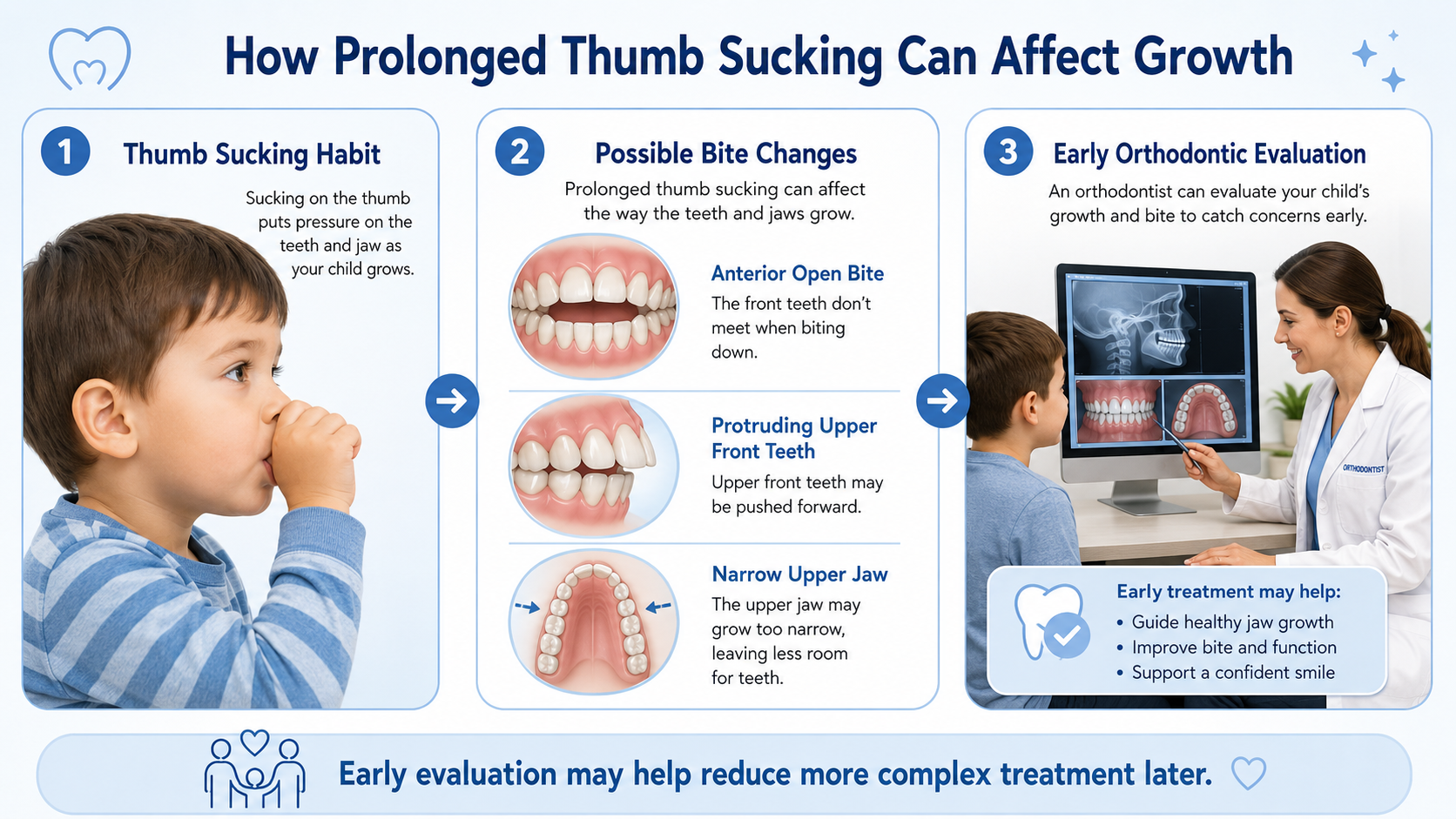
Prolonged thumb sucking can place pressure on a child’s teeth and jaws, sometimes leading to open bite, protruding front teeth, or a narrow upper jaw. Early orthodontic evaluation can help detect these changes before they become more difficult to correct.
Why Thumb Sucking Can Cause an Open Bite
One of the most common orthodontic effects of prolonged thumb sucking is an open bite. This happens when the upper and lower front teeth do not meet properly.
The thumb can push the upper front teeth forward while also preventing the front teeth from erupting into a normal position. As a result, a space may remain between the upper and lower front teeth even when the child bites down.
An open bite can affect chewing, speech, appearance, and tongue posture. If the habit stops early enough, some bite changes may improve naturally. If the habit continues too long, orthodontic treatment may be needed to correct the bite.
The Connection Between Thumb Sucking, Narrow Palate, and Breathing
Thumb sucking can also contribute to a narrow upper jaw, also called maxillary constriction. When the upper jaw becomes narrow, the dental arch may not have enough room for the permanent teeth to come in properly.
A narrow upper jaw may also affect nasal breathing. Because the upper jaw forms part of the floor of the nasal airway, poor upper jaw development can be associated with mouth breathing or reduced nasal airflow in some children.
Thumb sucking is not the only cause of breathing or airway problems. Tonsils, adenoids, allergies, nasal obstruction, tongue posture, and genetics can also play a role. However, persistent oral habits may contribute to a pattern of jaw and facial growth that deserves early attention.
Why Timing Matters
The younger the child, the more adaptable the developing jaws usually are. If thumb sucking is stopped while the child is still growing, some changes may partially or completely self-correct.
The front teeth may begin to close naturally, tongue posture may improve, and jaw growth may return to a healthier pattern.
However, once permanent teeth erupt and facial growth slows, spontaneous correction becomes less predictable. At that point, treatment may require more involved orthodontic care, such as:
- – Palatal expansion
- – Braces or clear aligners
- – Bite correction
- – Longer treatment time
- – Habit appliances, when appropriate
Early treatment can help prevent a small problem from becoming a more complex one.
When Should Parents Seek an Orthodontic Evaluation?
The American Association of Orthodontists recommends that children have their first orthodontic check-up by age 7. This does not mean every child needs braces at age 7. It simply allows the dentist or orthodontist to evaluate growth, tooth eruption, bite development, and harmful habits early.
For children who continue thumb sucking, an orthodontic evaluation may be helpful even earlier if parents notice:
- – Front teeth that do not touch
- – Upper front teeth beginning to protrude
- – A narrow smile
- – Crossbite
- – Difficulty chewing
- – Mouth breathing
- – Speech changes
- – Continued thumb sucking beyond age 4 or 5
An early evaluation may lead to monitoring, habit guidance, or treatment if needed.
How to Help a Child Stop Thumb Sucking
Stopping thumb sucking works best with encouragement, patience, and consistency. Punishment or shame can increase stress and make the habit harder to stop.
Helpful approaches may include:
- – Positive reinforcement
- – Reward charts
- – Identifying emotional triggers
- – Gentle reminders
- – Covering the thumb at certain times
- – Thumb guards
- – Habit appliances when recommended
- – Support from the dental or orthodontic team
Every child is different. Some children stop quickly with encouragement, while others need more structure and support.
Benefits of Early Orthodontic Care for Thumb Sucking
Addressing thumb sucking at the right time can help:
- – Support healthy jaw development
- – Reduce the risk of open bite
- – Reduce the risk of protruding front teeth
- – Improve facial balance
- – Encourage better tongue posture
- – Support healthier swallowing patterns
- – Improve speech development
- – Reduce the risk of trauma to front teeth
- – Lower the chance of more complex orthodontic treatment later
Early orthodontic care is not only about straight teeth. It is about guiding growth while the teeth, jaws, and facial muscles are still developing.
Final Thoughts
Persistent thumb sucking is more than a childhood habit. When it continues too long, it can act as a growth-modifying force that affects the teeth, jaws, facial muscles, bite, and sometimes breathing patterns.
The earlier the habit is addressed, the greater the opportunity to reduce orthodontic problems and support healthier facial development.
If your child continues to suck their thumb beyond the preschool years, or if you notice changes in their bite, smile, speech, or breathing, an orthodontic evaluation can help determine whether early intervention is needed.
At Ortega Dental Care, we can evaluate your child’s growth, explain what we see, and recommend the right timing for care. Schedule an evaluation to learn whether thumb sucking orthodontic treatment may be helpful for your child.