Can Early Orthodontic Treatment Help Children with Sleep Apnea?
The Connection Between Sleep Apnea and Early Orthodontic Treatment in Children
Many parents think of orthodontics as a way to straighten teeth, improve a child’s bite, or create a more confident smile. While those goals are important, early orthodontic care can also play a meaningful role in a child’s breathing, sleep quality, and overall development.
One area that has received growing attention is the connection between pediatric obstructive sleep apnea and early orthodontic treatment. This connection is real, but it is often oversimplified. Orthodontic treatment can help improve certain airway-related problems, especially when a child has a narrow upper jaw or dental crowding, but it is not usually a standalone cure for sleep apnea. The airway is complex, and sleep-disordered breathing can involve the tonsils, adenoids, nasal passages, jaw growth, tongue posture, allergies, weight, and muscle tone.
That is why
early evaluation matters. When dentists and orthodontists recognize certain growth patterns early, they can help families seek the right care before problems become more difficult to address.
What Is Pediatric Sleep Apnea?
Pediatric obstructive sleep apnea occurs when a child’s breathing is partially or completely blocked at times during sleep. This can lead to restless sleep, snoring, pauses in breathing, mouth breathing, daytime tiredness, difficulty focusing, behavioral changes, or poor growth.
Not every child who snores has sleep apnea, and not every child with crowded teeth has an airway disorder. However, certain dental and facial growth patterns can be warning signs that deserve closer attention.
Common airway-related concerns may include:
- A narrow upper jaw
- Crowded teeth
- A high, narrow palate
- Mouth breathing
- Low tongue posture
- Retruded lower jaw
- Open-mouth sleeping
- Enlarged tonsils or adenoids
- Chronic nasal congestion
When these signs appear together, an airway-focused
orthodontic evaluation may be helpful.
How Orthodontics Can Influence the Airway
Orthodontics does not directly treat every cause of sleep apnea, but it can influence the skeletal and dental structures that support healthy breathing. The upper jaw, lower jaw, palate, and dental arches all help shape the space available for the tongue and nasal airway.
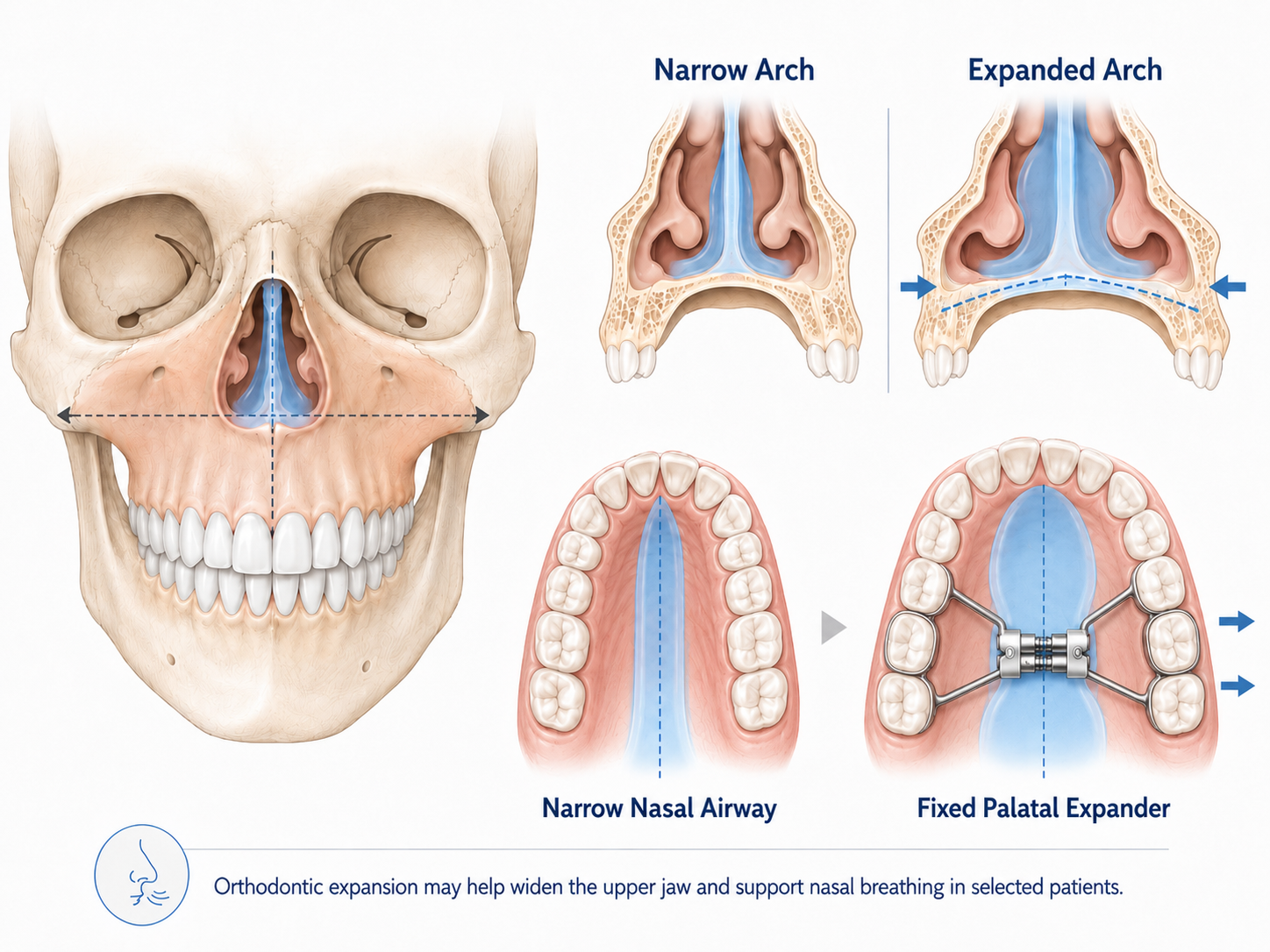
When the upper jaw is too narrow, the nasal floor may also be narrow. This can increase nasal resistance and make it harder for a child to breathe comfortably through the nose. Over time, mouth breathing can affect tongue posture, jaw development, facial growth, and bite alignment.
Early orthodontic treatment may help guide growth while the bones are still developing. This is why timing is important. In younger children, the jaw and palate are more adaptable, which can make certain treatments more effective than waiting until growth is nearly complete.
Rapid Maxillary Expansion and Pediatric Airway Health
One of the most commonly discussed orthodontic treatments related to pediatric sleep-disordered breathing is rapid maxillary expansion, often called RME.
RME is used when a child has a narrow upper jaw or transverse deficiency. The goal is to widen the upper jaw, improve the bite, and create more room for the teeth. Because the upper jaw forms part of the nasal cavity, expansion may also help improve nasal airflow in selected patients.
Potential benefits of rapid maxillary expansion may include:
- Widening the upper jaw
- Improving dental arch form
- Reducing crowding
- Improving nasal airflow
- Supporting nasal breathing
- Helping the tongue rest in a healthier position
- Improving bite development
Research has shown that some children with obstructive sleep apnea experience improvement after RME, including reductions in apnea-hypopnea index, also known as AHI. However, improvement does not always mean complete resolution. Some children still need additional care from an ENT physician, pediatrician, sleep specialist, allergist, or myofunctional therapist.
In other words, expansion may be an important part of the solution, but it should not be presented as the entire solution.
Why ENT Evaluation May Also Be Needed
Many children with sleep-disordered breathing also have enlarged tonsils or adenoids. In those cases, orthodontic treatment alone may not address the full problem. An ENT evaluation may be recommended to assess whether the tonsils, adenoids, nasal airway, or chronic congestion are contributing to the child’s breathing difficulties.
This team approach is important because pediatric sleep apnea is rarely caused by just one factor. A narrow jaw may contribute to airway restriction, but enlarged tonsils, allergies, nasal blockage, or poor tongue posture may also be involved.
The most successful care often happens when dental providers, orthodontists, physicians, and parents work together.
Signs Parents Should Watch For
Parents may want to schedule an
evaluation if their child shows signs such as:
- Frequent snoring
- Mouth breathing during the day or night
- Restless sleep
- Pauses, gasping, or choking sounds during sleep
- Waking up tired
- Difficulty focusing at school
- Bedwetting beyond the expected age
- Grinding teeth at night
- Crowded teeth
- A narrow smile
- A high palate
- Forward head posture
- Dark circles under the eyes
These signs do not automatically mean a child has sleep apnea, but they may indicate that further
evaluation is needed.
Why Early Orthodontic Screening Matters
The American Association of Orthodontists recommends that children have an
orthodontic evaluation by age 7. This does not mean every child needs braces at that age. It means the orthodontist can check how the jaws, bite, airway-related structures, and permanent teeth are developing.
Early screening can help identify problems before they become more severe. In some cases, early treatment may reduce crowding, improve jaw balance, support nasal breathing, and create better conditions for future orthodontic care.
For children with airway concerns, early screening may also help connect families with the right medical providers sooner.
Orthodontics Is Not a “Cure-All” for Sleep Apnea
It is important to be honest: orthodontic treatment should not be marketed as a guaranteed cure for pediatric sleep apnea. Sleep apnea is a medical condition that requires proper diagnosis, often through a physician and sleep study.
Orthodontics can help address certain structural contributors, especially narrow upper jaws and bite problems. But if the issue involves enlarged tonsils, adenoids, nasal obstruction, allergies, or other medical factors, those must be evaluated and treated appropriately.
The goal is not to oversell orthodontics. The goal is to recognize when orthodontic growth guidance may be one valuable part of a larger airway-focused care plan.
A Team Approach Leads to Better Outcomes
At Ortega Dental Care, we believe early evaluation can make a meaningful difference in a child’s growth, breathing, and long-term oral health. When we see signs of narrow arches, mouth breathing, crowding, or possible airway concerns, we may recommend further evaluation and coordinate care with the appropriate specialists.
Healthy breathing, restful sleep, proper jaw development, and a functional bite are deeply connected. By identifying concerns early, parents have more options and children may have a better chance to grow, sleep, and thrive.
If your child snores, breathes through their mouth, has crowded teeth, or shows signs of restless sleep, an orthodontic and airway-focused dental evaluation may be a helpful first step.
Early treatment is not about rushing into braces. It is about understanding your child’s growth, identifying concerns early, and creating a plan that supports healthy development.