Can Class II Malocclusion and Overjet Affect a Child’s Sleep and Learning?
Understanding the Possible Connection Between Jaw Development, Breathing, Attention, and Cognitive Development
When parents are told that their child has a Class II malocclusion, excessive overjet, or deep overbite, their first concern is often the appearance of the teeth. However, orthodontic problems in growing children can involve more than aesthetics.
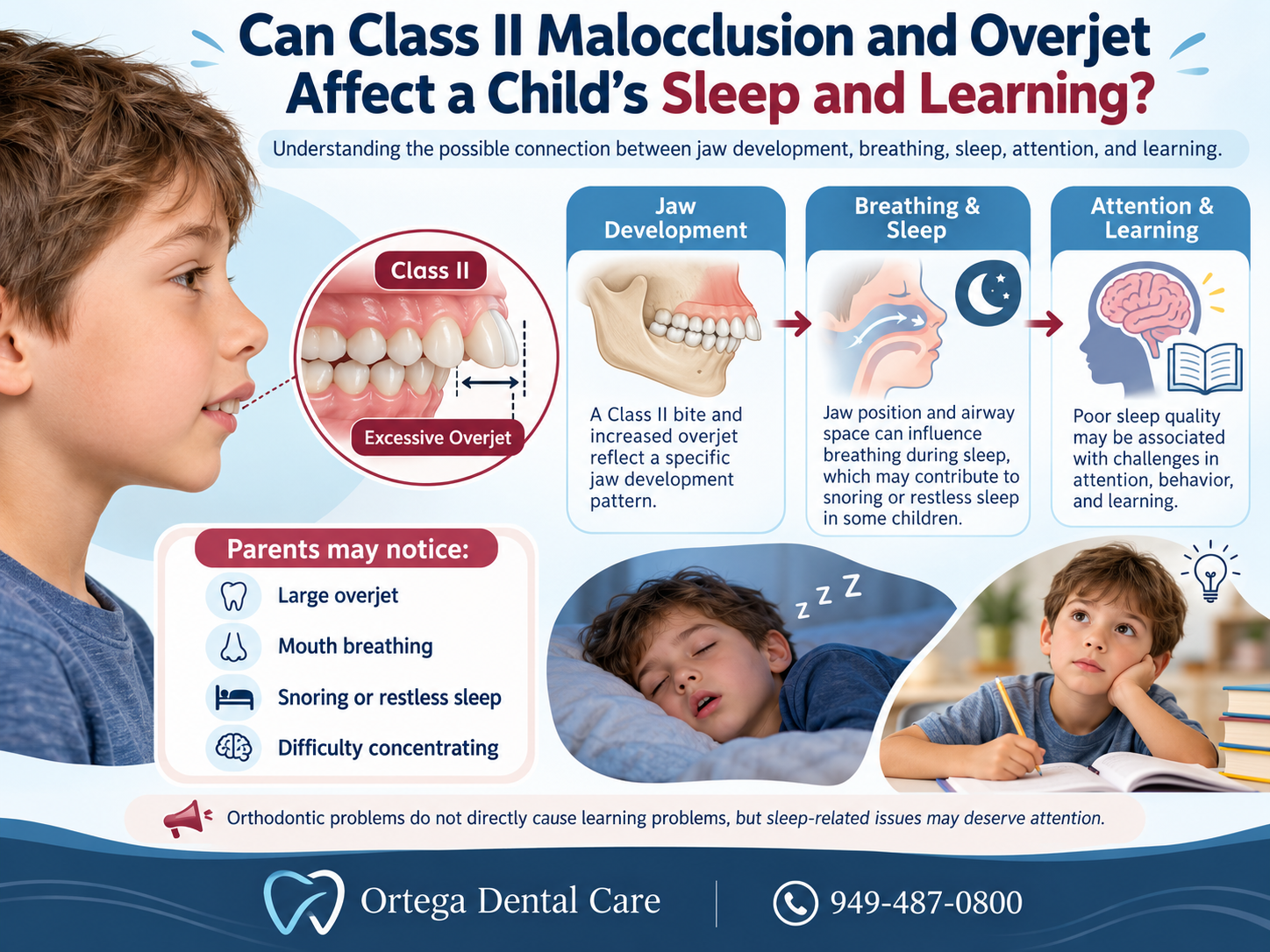
Class II malocclusion and sleep may overlap in some children because jaw development, facial growth, oral function, and breathing patterns are all connected parts of the developing craniofacial system. This does not mean a Class II bite directly causes learning problems. Instead, some children with certain jaw and airway-related features may also experience sleep-disordered breathing, which can affect sleep quality, attention, behavior, and learning.
Current research does not show that Class II malocclusion, excessive overjet, or deep overbite directly causes cognitive impairment. However, there is growing interest in the relationship between craniofacial development, airway function, sleep quality, attention, and cognitive development.
What Is a Class II Malocclusion?
A Class II malocclusion occurs when the upper teeth and/or upper jaw are positioned forward compared with the lower teeth and jaw. In many growing children, it may be associated with a lower jaw that sits farther back, known as mandibular retrusion.
Children with Class II malocclusion may also show:
- – Excessive overjet
- – Deep overbite
- – A retruded lower jaw
- – Lip incompetence
- – Mouth breathing
- – Altered tongue posture
- – Narrow dental arches in some cases
- – A convex facial profile
The cause and severity can vary from child to child. That is why an orthodontic evaluation should look beyond the teeth and consider facial growth, jaw relationships, oral function, and overall development.
Why Excessive Overjet Matters
Overjet is the horizontal distance between the upper and lower front teeth. A small amount of overjet is normal. Excessive overjet occurs when the upper front teeth sit significantly ahead of the lower front teeth.
Large overjet matters for two main reasons. First, protruding upper incisors are more vulnerable to injury. Cochrane evidence suggests that early orthodontic treatment for children with prominent upper front teeth can reduce the risk of new incisor trauma compared with waiting for one course of treatment in adolescence.
Second, excessive overjet may be a visible sign of an underlying skeletal pattern, especially when the lower jaw is significantly retruded. In a growing child, identifying this early allows the dentist or orthodontist to determine whether growth monitoring or growth modification may be appropriate.
What Is a Deep Overbite?
A deep overbite occurs when the upper front teeth vertically overlap the lower front teeth too much. A severe deep bite can affect how the front teeth contact and function.
A deep overbite should not be described as a direct cause of learning problems. Its importance depends on the child’s full clinical picture, including skeletal relationships, facial growth, dental development, oral habits, and sleep-related symptoms.
Class II Malocclusion and Sleep: Why Parents Should Pay Attention
Sleep is essential for a child’s developing brain. Poor-quality or disrupted sleep can affect attention, memory, behavior, emotional regulation, and learning.
Sleep-disordered breathing includes a range of breathing problems during sleep, from habitual snoring to obstructive sleep apnea. Research has found associations between pediatric obstructive sleep apnea and neurocognitive difficulties, including areas such as attention, executive function, working memory, intelligence, and phonological processing. A 2026 systematic review and meta-analysis focused on children with polysomnography-confirmed OSA and directly enrolled healthy non-snoring controls.
This does not mean every child with Class II malocclusion has a sleep disorder. It also does not mean every child who snores will have learning difficulties. It simply means sleep quality deserves attention when a child has significant orthodontic findings together with symptoms such as snoring, mouth breathing, restless sleep, or daytime behavioral changes.
Could a Class II Bite Be Related to Learning?
A Class II bite does not automatically cause learning problems. The connection, when present, is usually more indirect.
A more accurate way to explain it is:
Some children with certain craniofacial characteristics may also have sleep-disordered breathing. If sleep is disrupted, that poor sleep quality may contribute to attention, behavior, memory, and learning difficulties.
This distinction is important. The bite itself should not be blamed for school challenges. Instead, the child’s overall growth, breathing, sleep, and function should be evaluated together when symptoms suggest a broader issue.
Signs Parents Should Watch For
Parents should discuss their child’s sleep with a pediatrician or healthcare provider if they notice:
- – Loud or frequent snoring
- – Mouth breathing during sleep
- – Pauses in breathing
- – Gasping or choking during sleep
- – Restless sleep
- – Frequent nighttime awakenings
- – Unusual sleeping positions
- – Difficulty waking in the morning
- – Daytime fatigue
- – Irritability
- – Difficulty concentrating
- – Behavioral changes
- – Declining school performance
Children with disrupted sleep do not always look sleepy during the day. Some children may appear hyperactive, inattentive, irritable, or emotionally dysregulated instead.
Why Early Orthodontic Evaluation Matters
The American Association of Orthodontists recommends that children have their first orthodontic check-up no later than age seven. By this age, an orthodontist can evaluate how the teeth and jaws are developing, even when some problems are not obvious at home.
For a child with significant Class II skeletal discrepancy, excessive overjet, or severe deep overbite, an early orthodontic evaluation can help determine:
- – Whether the problem is primarily dental or skeletal
- – How severe the discrepancy is
- – Whether mandibular retrusion is present
- – Whether abnormal oral function is present
- – Whether there are signs that warrant airway or sleep evaluation
- – Whether treatment should begin now or be monitored
An early evaluation does not always mean a child needs braces immediately. In many cases, observation and growth monitoring may be the most appropriate recommendation.
Can Orthodontic Treatment Improve Sleep?
This remains an active area of research. Some studies suggest that certain orthodontic approaches, such as functional mandibular advancement or rapid maxillary expansion, may improve some sleep-related outcomes in selected children with sleep-disordered breathing.
However, orthodontic treatment should not be presented as a guaranteed treatment for sleep apnea, attention problems, or cognitive concerns. Children with suspected sleep-disordered breathing should be evaluated by the appropriate medical provider.
The Bigger Picture
A child’s teeth are only one part of a developing craniofacial system. When evaluating a child with significant Class II malocclusion, excessive overjet, or deep overbite, the dentist or orthodontist should consider facial growth, skeletal relationships, dental development, oral function, breathing patterns, and sleep-related symptoms.
The goal is not to suggest that orthodontic problems directly cause learning disabilities. The goal is to recognize that healthy childhood development involves more than straight teeth.
If a child has a significant jaw discrepancy along with snoring, mouth breathing, restless sleep, difficulty concentrating, behavioral changes, or unexplained academic struggles, it may be appropriate for the child’s healthcare team to look at the bigger picture.
Early Evaluation Means Early Understanding
A significant overjet, deep overbite, or Class II malocclusion in a growing child deserves a professional orthodontic evaluation. Not simply because of appearance, but because understanding the child’s overall growth and development can help determine the right timing and type of care.
Early orthodontic evaluation does not necessarily mean early treatment. It means early understanding, appropriate monitoring, and timely intervention when needed.
At Ortega Dental Care, we evaluate each child’s bite, jaw growth, facial development, oral function, and related concerns. If your child has excessive overjet, a deep overbite, mouth breathing, snoring, or concerns with jaw development, our office can help determine whether an orthodontic evaluation or additional referral may be appropriate. Patients can also contact our office directly or request an appointment through our website.