Warning. Signs Your Child May Need Early Orthodontic Evaluation
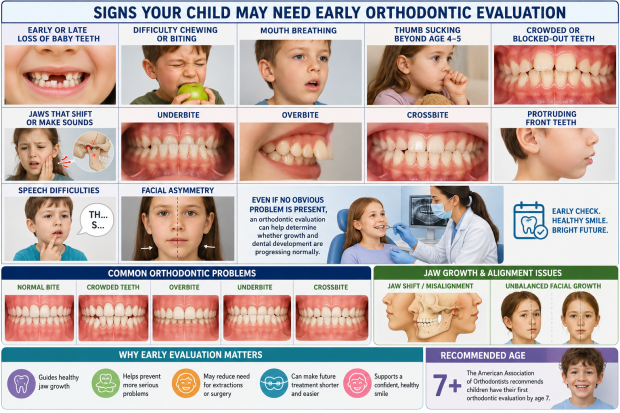
Parents should watch for the following signs:
- Early or late loss of baby teeth
- Difficulty chewing or biting
- Mouth breathing
- Thumb sucking beyond age 4–5
- Crowded or blocked-out teeth
- Jaws that shift or make sounds
- Underbite, overbite, or crossbite
- Protruding front teeth
- Speech difficulties
- Facial asymmetry
Even if no obvious problem is present, an orthodontic evaluation can help determine whether growth and dental development are progressing normally. “At Ortega Dental Care, we recommend early orthodontic evaluations to help identify developing bite and jaw issues before they become more severe. Early treatment can often simplify future orthodontic care and support healthy facial growth.”
FAQs:
- At what age should a child first see an orthodontist?
The American Association of Orthodontists recommends children have their first orthodontic evaluation by age 7. Early evaluations help identify bite and jaw issues while the mouth is still developing.
- What are the early signs that my child may need braces?
Common signs include crowded teeth, difficulty chewing, mouth breathing, thumb sucking, speech issues, and noticeable bite problems such as overbites or underbites.
- Can thumb sucking affect my child’s teeth and jaw development?
Yes. Thumb sucking beyond age 4–5 can affect jaw growth and tooth alignment, potentially leading to bite problems that may require orthodontic treatment.
- Is mouth breathing harmful to dental development?
Mouth breathing can influence facial growth and jaw development over time. It may also contribute to bite issues and crowded teeth.
- What causes crowded teeth in children?
Crowding can result from genetics, early or late loss of baby teeth, jaw size differences, or habits like thumb sucking.
- How do I know if my child has an overbite or underbite?
An overbite occurs when the upper front teeth excessively overlap the lower teeth, while an underbite occurs when the lower teeth sit in front of the upper teeth. An orthodontic evaluation can confirm the severity.
- Can early orthodontic treatment prevent braces later?
Early treatment may reduce the severity of future orthodontic problems and sometimes shorten or simplify later treatment, though braces may still be needed.
- What is Phase 1 orthodontic treatment?
Phase 1 treatment is early orthodontic care designed to guide jaw growth and correct developing bite issues while children still have baby teeth.
- Why is early orthodontic evaluation important?
Early evaluations help detect problems before they worsen, allowing treatment to begin at the most effective stage of growth.
- Can orthodontic problems affect speech development?
Yes. Certain bite problems and jaw alignment issues can contribute to speech difficulties in some children.
- What happens during a child’s first orthodontic consultation?
Your Doctor examines the teeth, jaws, and bite, may take X-rays or photos, and discusses whether treatment or monitoring is recommended.
- Does my child need braces if baby teeth are still present?
Not always, but orthodontic evaluations during this stage can identify developing problems early and determine if treatment is needed.
- Are jaw clicking or shifting signs of orthodontic problems?
They can be. Jaw sounds or shifting may indicate bite imbalances or jaw alignment concerns that should be evaluated.
- How can early orthodontics improve facial development?
Early orthodontic treatment can help guide jaw growth, improve bite alignment, and support balanced facial development.
- What is the difference between a pediatric dentist and an orthodontist?
A pediatric dentist focuses on children’s overall dental health, while an orthodontist specializes in correcting bite and tooth alignment issues.
- Can early orthodontic treatment help avoid tooth extractions?
In some cases, early treatment can create space for incoming teeth and reduce the likelihood of extractions later.
- Is age 7 too early for an orthodontic evaluation?
No. Age 7 is often ideal because many orthodontic issues can be identified while the jaws are still growing.
- How long does early orthodontic treatment usually take?
Treatment length varies, but many Phase 1 treatments last between 9 and 18 months depending on the child’s needs.
- What orthodontic problems become worse if untreated?
Crowding, crossbites, jaw imbalances, and protruding teeth may worsen over time if not monitored or treated early.
- How often should children have orthodontic evaluations?
Children should continue routine dental visits, and orthodontic follow-ups are typically recommended based on growth and development.